

My Darling Lily
HAPPY NEW YEAR

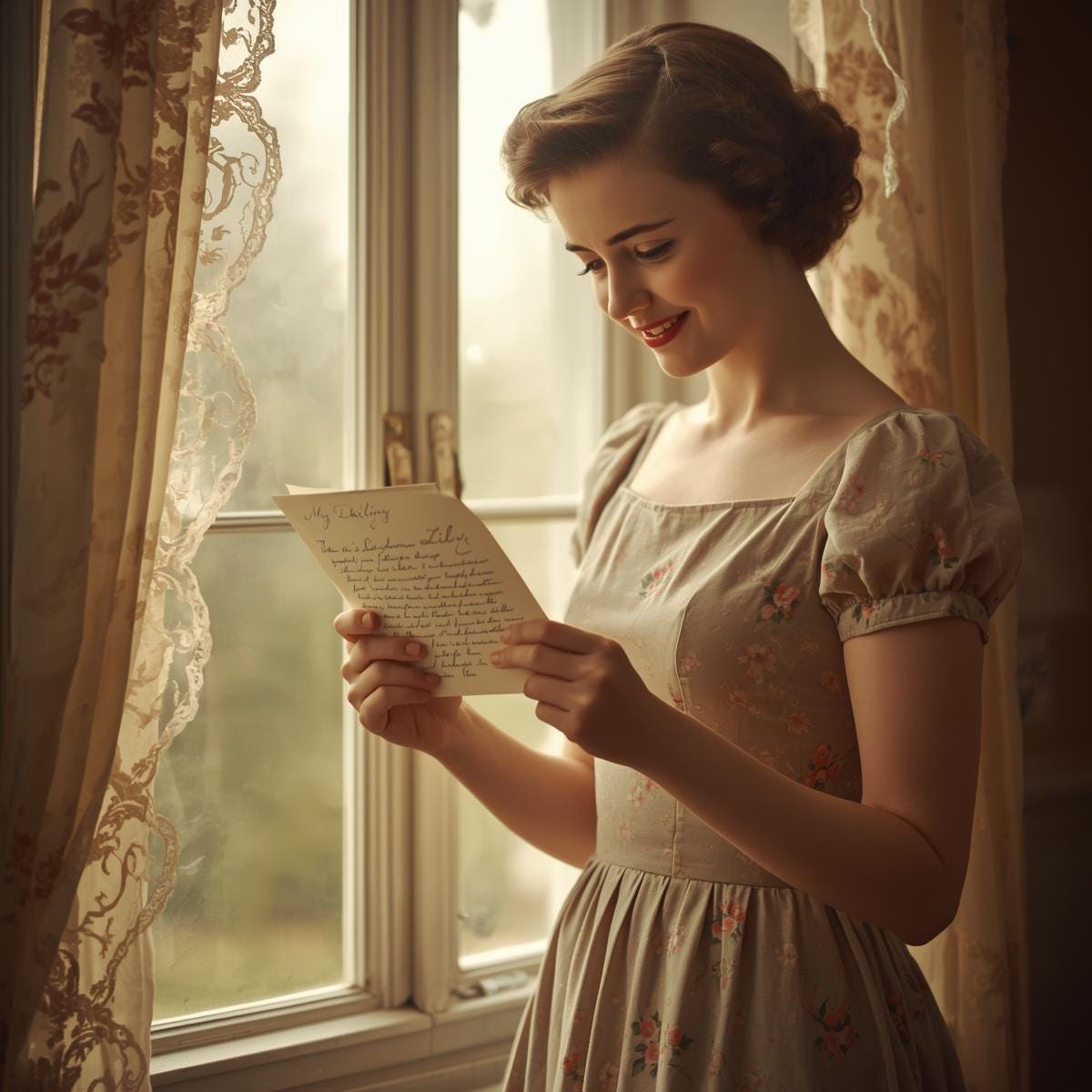
My Darling Lily,
Your letter arrived on the morning of the 30th, and I have read it no fewer than twenty-three times since. (Yes, I’m counting. You’ve made a meticulous record-keeper of me.) I carried it with me to the New Year’s Eve service at St. Margaret’s, tucked safely in my breast pocket, close to my heart where it belongs. When Reverend Thompson spoke of new beginnings and God’s faithfulness, I could feel the weight of your words against my chest, and I thought: here is my new beginning. Here is evidence of God’s faithfulness made tangible in cream-coloured stationery and elegant script.
I must tell you, my love, that your letter has quite ruined me for ordinary correspondence. You write the way you laugh, with your whole heart, holding nothing back, and it is glorious.
First, let me address the matter of the gifts. You needn’t thank me so profusely, though I confess I rather enjoy it when you do. The chocolate was hardly an act of heroism, my darling. As for the bracelet, it belonged to my grandmother. She gave it to me shortly before she passed, with strict instructions that it should go to “the girl who makes you forget to be sensible.” The moment I met you, Lily, at the Harrisons’ garden party when you argued so passionately about women’s suffrage that you knocked over Lady Harrison’s prized roses, I knew you were that girl. You make me forget to be sensible daily, hourly, if I’m honest.
Your description of the Christmas visit to Mrs Caldwell has stayed with me, Lily. Little Thomas and his wooden horse. The look on his face. The gratitude for something we might consider simple, yet to him was a treasure. It reminded me of something that happened here just last week, and I’ve been meaning to tell you about it.
I was walking home from chambers late one evening, defending a rather tedious contract dispute that required an unconscionable amount of paperwork, when I encountered a young boy, no more than ten, sitting on the church steps in the cold. He was thin, poorly dressed, and clearly alone. When I asked if he needed help, he looked up at me with the most solemn expression and said, “I’m waiting for God to answer my prayer, sir. Mum says He always answers, but you have to wait proper-like.”
I sat down beside him (much to the detriment of my good trousers) and asked what he was praying for. He told me his mother was ill, that they’d had no coal for the fire for three days, and that he’d prayed for help but didn’t know when it would come.
Lily, my heart broke right there on those cold stone steps.
I took the boy home, met his mother (who was indeed quite ill), and arranged for coal to be delivered immediately. I also contacted Dr Matthews, who agreed to call on her without charge. Before I left, I pressed a few pounds into the boy’s hand, enough for food and medicine, and told him that God sometimes answers prayers through people, and that he should never stop praying or believing.
Do you know what he said to me? He said, “You must be one of God’s special messengers, sir, the kind with wings tucked under their coats so nobody notices.”
I’ve thought about that every day since. About how we are, all of us, meant to be answers to someone’s prayers. About how love is meant to have hands and feet and sometimes muddy trousers.
That’s what I’m taking into 1926, Lily.
This past year has been one of remarkable growth for me, though I didn’t fully recognise it until your letter crystallised everything so beautifully. In 1925, I learned what it means to love someone properly, not the schoolboy infatuation of my university days, but the deep, abiding commitment to another person’s flourishing.
I’ve also been giving serious thought to the future and the kind of life I want to build. The law practice is going well, better than well, actually. We’ve taken on two new associates, and I’ve been asked to consider a partnership. It would mean more responsibility, certainly, but also more stability and a greater ability to provide for a family. (I trust you take my meaning.)
But beyond the practical considerations, I’ve been thinking about what it means to build a life of purpose. I want our home, when we have one, to be a place of warmth and welcome. A place where we will raise our children with love. A place where young boys with impossible prayers might find answers. A place that reflects the love that has been so generously poured into us.
I’ve been reading more, too. Theology, mostly. Trying to understand better the faith that has sustained us both, the foundation on which I hope to build our marriage. Father Benedict has been kind enough to meet with me weekly for discussions ranging from doctrine to practical Christian living. He asked me last week what I hoped to accomplish in 1926, and I told him: “To become the kind of man worthy of the woman I love, and the kind of husband who reflects Christ’s love for His church.”
He smiled and said, “That’s a lifetime’s work, my boy.”
“Good,” I replied. “Because I’m hoping for a lifetime with her.”
Now, regarding this business of falling off Clementine. Lily Elizabeth Hartwell, you cannot write such things casually! “The thought of not seeing you again if I don’t make it alive broke my heart before I landed in the mud…” Darling, my heart stopped when I read that sentence. I know you meant it somewhat playfully, but the very thought of a world without you in it is intolerable to me.
You wrote that I make you feel like Helen of Troy. Do you know what you make me feel like? Like Paris, certainly, but also like the luckiest man in all of England. Like someone who stumbled upon treasure while looking for something ordinary.
I love everything about you, Lily. I love your passionate arguments about literature and politics. I love how you get indignant on behalf of people you’ve never met. I love your terrible singing voice (yes, it’s terrible, and no, I won’t stop asking you to sing). I love how you cry at weddings and laugh at funerals when someone tells a good story about the deceased. I love your fierce loyalty to your sister, Ella, and your patient tolerance of Ray’s mischief. I love how you see the best in people, even when they don’t deserve it.
This morning, as 1926 dawned cold and bright, I stood at my window, watching the sun rise over London, and thought about new beginnings. About the year ahead and all it might hold. About the life I hope to build with you, God willing. I thought about my career and the new opportunities it presents. I thought about how far the Lord has brought me. And I thought about you, my darling Lily, marking off days on your calendar, wearing my grandmother’s bracelet, and refusing dances because you’re waiting for me.
I am the most blessed of men.
This is my promise to you as we enter 1926: I will love you faithfully. I will honour the gift you are. I will strive daily to be the kind of man who deserves your affection. I will meet you at the altar (should you say yes, which I’m rather hoping you will) with a full heart and a clear conscience, ready to build a life that reflects the grace we’ve been shown.
Until then, know that you are thought of constantly, prayed for daily, and loved more deeply than words can adequately convey.
I love you. I wanted to say it once more, plainly, without flourish or metaphor.
I love you, Lily, with everything I am.
Yours,
Edward
January 1, 1926
Featured Story of The Week!
Absolutely beautiful 💝
It's kinda poetic how you employed epistolary form to create a dialogue across time, turning the letters into a serialized narrative that builds anticipation and emotional depth... It's absolutely a masterpiece 🏆